Friday, June 29, 2012

Preserving: Tonno Sott' Olio


Tonno Sott' Olio
Recipe by Rosetta Costantino


Recently I've been favoring recipes that call for tonno sott' olio - tuna preserved in olive oil. The commercial product available here in the USA is very expensive. Fortunately, it turns out to be pretty easy to make. The tuna still ain't cheap (my tuna was $17.99 a pound so I'm "saving" about $15 versus buying the imported product) but for anyone with a pressure canner or two, it's an interesting change from the annual cycle of vegetable canning that culminates with an orgy of tomato processing in late summer.

There are (at least) three main approaches to making tonno sott' olio at home. One involves a pickling brine with vinegar, salt and various aromatics. Mario Batali has a representative recipe of this type, Fresh Canned Tuna, as does Lidia Bastianich. Note that both these recipes produce a product meant to be refrigerated.

The second approach uses a simple brine: water and salt; the versions differ mainly in the amount of salt used. This is the approach I'm using, as described by Rosetta Costantino in My Calabria: Rustic Family Cooking from Italy's Undiscovered South.

The third approach involves pressure canning fresh, uncooked fish with a little salt and olive oil. Some sources recommend this approach for any fish except tuna, others apply it to tuna as well.

This being SAI's first pressure canning recipe of the season, now would be a good time to drag out your equipment and check it over. I found that the over pressure plug on mine and gotten a tiny cut sometime over the winter - that would have made quite a mess had it blown out.

And for more exciting canning blogification:


Laura Williams' Musings

Tuesday, June 26, 2012

The Brothels of Pompeii - Part 3

VII 2,28 VII 12,33
This is the third and (probably) last post on the cellae meretriciae or brothel cribs, of Pompeii. Part 1 covered one of the better preserved cribs, located at the rear of an enourmous elite house the Casa della Caccia Antica. Part 2 dealt with three separate cribs, all adjacent to a taberna situated just off Pompeii's main ceremonial street. In this post we'll take a look at a crib that's probably not and a huge (relatively speaking) crib that may have been built to accomodate the customers of an adjacent hospitium (a sort of rooming house) and overflow from the Purpose Built Brothel.

VII 2, 28 - Circular Window
The first crib is located at VII 2, 28 on the map. It's one of the least well preserved of all the cribs in my survey but it does have someinteresting elements. Like all most all the other cribs, it's built into an elite house; in this case the Casa di Mercurio. There's also a small caupona to the south and an officina immediately to the north. All save the crib itself are accessible from Casa di Mercurio. Most unusual however is the fact that this crib appears to be a duplex. The "door" immediately south at VII 2, 29 is actually the remains of a stairway. As you can see from the photograph, there are clear indications that the crib was on the ground floor of a two story operation.

As in the case of Casa di Ganymede described in Part 2, it appears that once again we have a case of what might be called an integrated hospitality complex with food, drink, and companionship all available. However...

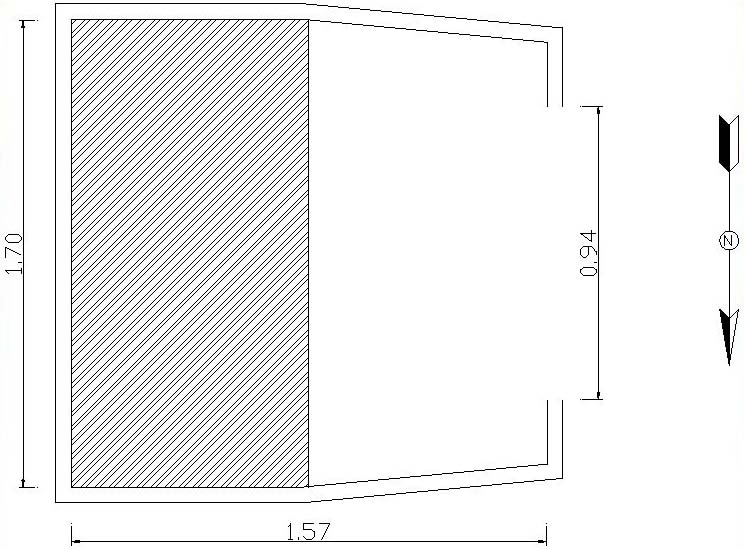
VII 2, 28 is the smallest of the cribs, about 2.2 m2; all the rest are 50% or more larger save one which is about 25% larger. In addition, the only indicator of a crib here is the masonry "bed". No graffiti or erotic art are reported. While it is certainly possible this was a crib, I think it just as likely it was a watchman's shelter or something similar.

VII 2,28 Plan
Here's the actual layout. You can see that  with a total depth of only about 1.5 meters, there's not much room to maneuver. If you were to sit on that masonry bed, you could probably trip pedestrians by simply by sticking out your foot.


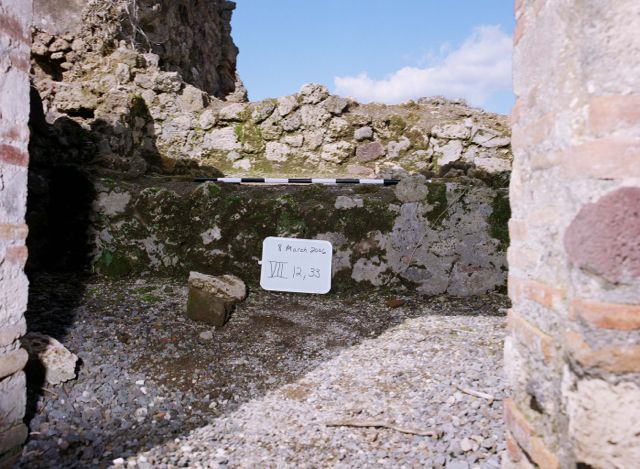
VII 12,33 - That's about as high as the interior walls get
 Finally we come to the crib at VII 12, 33. It's just about the least well preserved of all. The walls have almost completely collapsed and there's virtually no trace of any decoration. It's interesting primary because of it's location. It lies on Vico di Balcone Pensile a street named for the rooming house whose balcony extends over the sidewalk. Just to the west and around the corner is a small hospitium or stabulum from which this crib seems to have been carved.

The nearness of a pair of rooming houses as well as the presence of the Purpose Built Brothel two blocks to the east suggest the owner of the hospitium meant to encourage those staying at one of the rooming houses to spend their money locally rather than wandering down to the main brothel.

VII 12,33 Plan
Because of it's enormous size in relation to the other cribs (it's twice as big as  average) I suspect that while it's construction obviously wasn't entirely "up to code" it was likely decorated to at least simulate a luxurious cubiculum.


What do we have after all this? For years scholars have believed that there was a sort of zoning going on with regard to the location of the cribs and the Purpose Built Brothel, most notably Laurance and Wallace-Hadrill. Their arguments range from some sort of moral geography that placed these establishments away from the religious and ceremonial centers to the idea that the delicate sensibilities of the elite would be mortally offended by the sight of prostitutes roaming their streets.

In fact, there is plenty of literary evidence that prostitution was ubiquitous at least in Rome from the first century BC at least until the time of Anastasius. McGinn argues, correctly in my opinion, that Roman elites were indifferent to prostitution and the evidence from Pompeii surely suggests that they were willing and able to squeeze any profit from it they could.

In fact, the simplest explanation of the locations of the cribs and Purpose Built Brothel is economic: they're where the customers are.

So, next time you happen to be in Pompeii, impress your friends and fellow tourists with your intimate knowledge of Pompeii's "Red Light District".

Sunday, June 24, 2012

#MeatlessMonday - Garden Pizza #1


Garden Pizza #1
Recipe by Bill C
Made with the first few vegetables from our little garden.

Ingredients
  • 250 g. Bread Flour
  • 200 g. Water
  • 5 g. Salt
  • 1 Tbs Olive oil
  • 1/2 pkt. Active Dry Yeast
  • 1 Small Italian or Japanese Eggplant
  • 1 Small Zucchini
  • 28 oz Can Peeled Tomatoes
  • 4 oz. Fresh Mozzarella
  • Olive Oil
  • Salt
  • Pepper

LinkWithin

Related Posts Plugin for WordPress, Blogger...